After 3 years of running at low HR I discovered some new ideas about 6 months ago and my race times, training enjoyment, recovery times, and run-life balance have all improved. I have read at least a dozen well known books. This boom explains things better and is easier to understand than any so far. I am 60 yo 175 lbs, and am now running some of the best training and racing of my life.
The Nine Mile Marathon, Run Less Run Faster, and Run By Heartrate (which directly references this book) are all good and really helped me switch away from the long slow miles, high mileage weeks, long long runs, and cumulative fatigue that so many books, videos, and training plans promote.
Then I discovered this book just 2 weeks ago. The author really digs in and gets to the heart of the Why, with detailed explanations of the physiology, which are easier to understand than The Big Book of Endurance Training and Racing, 80/20Running, and several others I have read.
This book also gives some excellent starting points for the Whats and Hows that are easy to understand and adopt.
Having spent hundreds of hours reading books, blogs, articles, and watching countless YouTube videos, I will say that this book is what I have been looking for and I cannot recommend it more highly. It is a hidden gem.
Easy Interval Method available in English, German and Dutch (see below)
(This website only uses cookies for remembering login data and counting the number of visitors.)
When is a training approach truly suitable for the majority of runners — for the everyday runner? Is it when the method is derived from the schedules of elite athletes - who reached the top through a kind of “survival of the fittest,” where many dropped out under the strain of heavy training and only the very best remained? Or is it when the approach resonates with the majority of ordinary runners — and only later do elite runners gradually and cautiously add extra elements on top??
Welcome to the website dedicated to the book "Easy Interval Method". This successful training approach is truly unique, offering easy interval training as your foundational training in place of endurance runs. It is applicable for distances ranging from 800m to the marathon. Both elite and casual runners have greatly benefited. Numerous runners who switched from an 80/20 approach to the Easy Interval Method have been pleasantly surprised by smoother, faster running and an overall fitter feeling. Some who initially adopted the Norwegian Double Threshold approach, which includes several comparable sessions (but heavier due to shorter recoveries after a faster part), also saw benefits as the Easy Interval Method proved to be lighter and more efficient. Recently the Norwegian Singles Approach draws attention, but still the Easy Interval Method seems to be lighter (longer recoveries), and more effective for 800m up to 10km and for runners who need more 'pop' 'bounce' in their legs.
Masters runners especially, experience easy interval training as refreshing and revitalizing. They have been pleasantly surprised by the smoother, faster running and an overall fitter feeling.More than 40 testimonials located midway on this page stand as proof of these experiences. But better click here, for the document '100 reviews Easy Interval Method'.
Download a preview here (with a summary of what you can expect in the book + many reviews of enthusiastic readers)
Order at Amazon (hard copy + eBook): here.
Order at Apple in USA: https://books.apple.com/us/book/id6445219235
Order at Apple in UK: https://books.apple.com/gb/book/id6445219235
Oder at Apple in Australia: https://books.apple.com/au/book/id6445219235
Order at Apple in Canada: https://books.apple.com/ca/book/id6445219235
For Apple in 27 other countries: fill in your country domain extension, for example DE, FR, IT instead of US.
Order ad Kobo (eBook) here.
Jetzt auch auf Deutsch erhältlich !
Nederlandse versie Het Duurloopmisverstand, met de Souplessemethode
Perform easy interval training instead of most of your endurance runs
As a distance runner, are you tired of long, slow runs? Do you often feel sluggish and flat and, despite doing your regular long runs, can never quite improve on your personal best times? If so, The Easy Interval Method may be just the book for you! Nearly all endurance runs are replaced by mostly relaxed interval training (think 'Zatopek'), which will benefit your high-end (as well as low-end) aerobic power and running economy. Easy interval training is the base of an EIM training schedule, instead of many endurance runs.
Some advantages of the Easy Interval Method as experienced by users:
* Lighter but more effective training program.
* More fun in training.
* More reactivity in their legs (which gives a better running economy and improved
biomechanics when running); better finishing sprint; feeling more power and lighter on their feet.
* Improved lactate clearance helps you to run at higher speed with lower acidification.
* Most runners report fewer injuries (once used to this way of training).
* The best training for older and master runners to maintain speed and reactive running.
* Fitter and better prepared for races.
* Faster recovery after races.
* Able to run more races.
* Looking forward to each training session.
* A middle distance runner only needs to do around 30% or less of the heavy anaerobic training
compared to ‘traditional’ training runners.
* Much quicker return to fitness after a period of not training, after illness or injury.
- Read enthusiastic reviews at the bottom here at Amazon: https://www.amazon.co.uk/Easy-Interval-Method-Klaas-Lok/ AND
- Read this great article written by Andy Waterman: https://medium.com/@andywaterman/reactivity-806ec9694fc3
More:
- Interview with Peter Brady on mastermilers.com
- (26 Jan 2021) https://www.fastrunning.com/running-athletics-news/looking-for-igloi-in-the-21st-century/31745
- (17 March 2021) Book Review on Fastrunning: EIM by Klaas Lok
- Experiences of runners in the Easy Interval Group on Facebook
- (30 Dec 2021) Article about the training of Ingebrigtsen in which Easy Interval Method is also been discussed
- (6 Sept 2023) Article of Tom Shax, in which he discusses his experience regarding the benefits of EIM compared to 80/20 approach
- Youtube video in which Patrick Martin discusses his experience regarding the benefits of EIM compared to 80/20 approach
- Article of Nate Jenkins: The Importance of Running Specific Musculoskeletal Streng
- Research by Belgium exercise physiologist Eline Lievens found that athletes with around 50-50% distribution of slow- and fast twitch fibers (can even be 30-70 or 40-60) need more recovery time compared to athletes with around 80-20% distribution. Click here for an article with a summary or here for the full report of the research.
She told me: "It is indeed true that top runners will probably have a slower muscle fiber type than the 'average' runner. The average runner, with more type II fibers, will have to recruit those fibers to make adjustments. The type II fibers can be trained more aerobically, but this will not be possible through slow endurance running, it will require a little more intensity."
The Easy Interval Method is ideally suited for this purpose, and as an added benefit, it can significantly improve your running economy. This is particularly advantageous for 'every-day' runners who frequently have an imbalanced ratio of slow runs to interval sessions.
Canadian runner Jonathan S: "The easy interval method is truly a gem. Forget the Vaporfly, this is the best thing any runner could buy. For real!"
About the author
The book Easy Interval Method was written by Klaas Lok, a 24-time Dutch national champion. He won titles over 1500m (3:38) up to 10,000m (28:24) and cross country and finished 2nd in the European Indoor Championships and 20th in the World Cross-Country Championships, both in 1980.
More about the book
The book challenges many of the usual training protocols and guidelines associated with distance running. Avoiding long runs in favour of relaxed, easy interval training, Klaas presents a strong and intriguing case to get athletes moving smoother, stronger and faster with fewer injuries.
The Easy Interval Method contains detailed schedules for all distances from 800m to marathon. Using the principles described in this book, elite athletes have won many Dutch titles, set several national and World Masters records and even won Olympic and World championship medals. More casual runners have also surprised themselves by greatly improving their personal best times, even after years of stagnation. The book is a bestseller in Holland and is now available for the first time in English.
Easy Interval Method, a book with a training method that - according to so many runners who apply it - could be the best, the most pleasant and most efficient way of training.
(Read the article by Adri Hartveld: 'Recovery after strenuous exercise generally takes about a week' . It supports the power of easy interval training.
Read the article: Why the Easy Interval Method could be better than a polarized approach for 'normal' runners )
Read on below the photo.
Striking successes
- Dutchman John van der Wansem ran 2 masters world records.
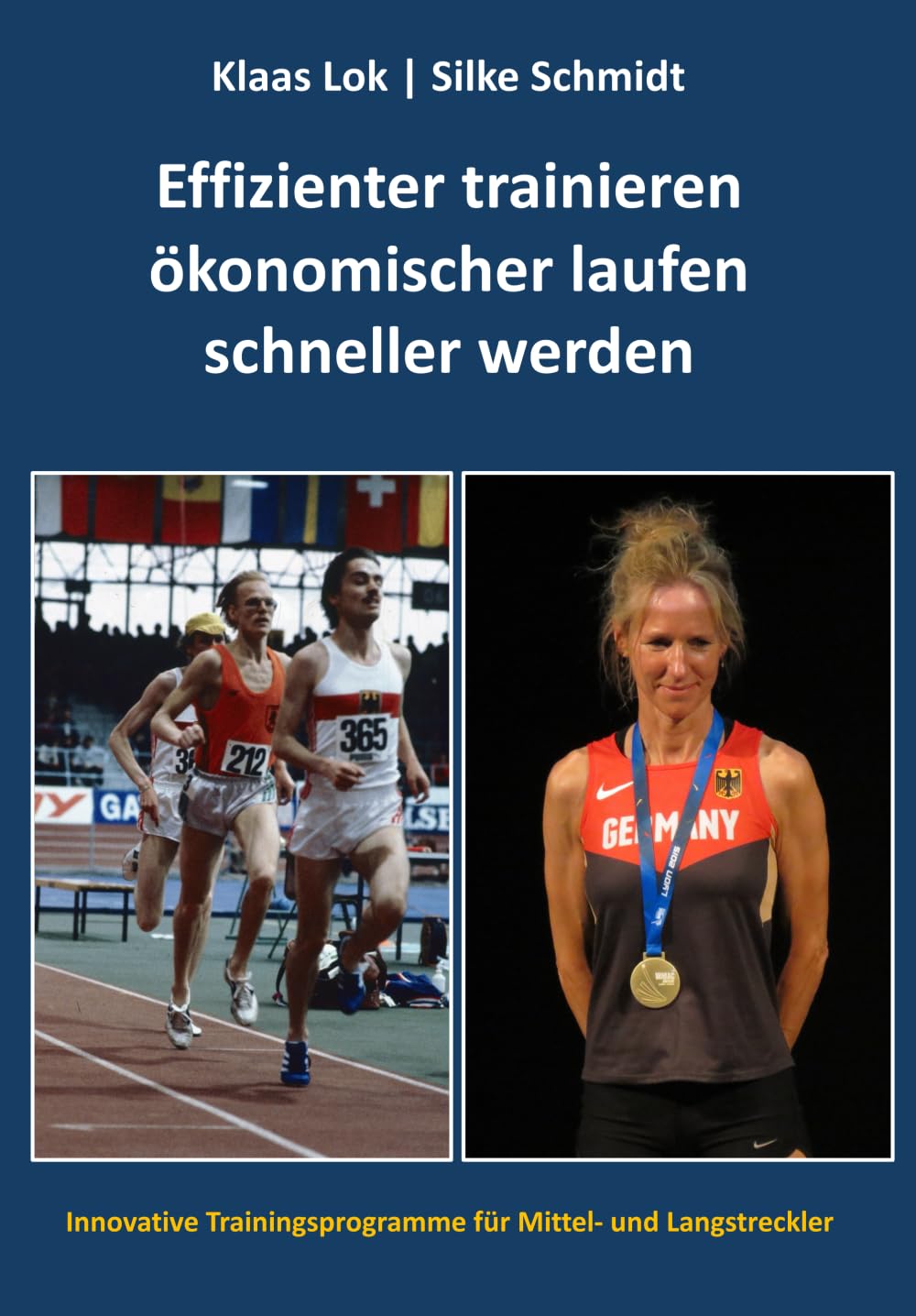
- German master runner Silke Schmidt (IAAF master athlete of the year 2015) did even better with 11 world records and 4 world titles.
- Olympic champion 1500m (2016) Faith Kipyegon and world champion marathon Geoffrey Kirui (2017) won their medals when training with easy-interval advocates Piet de Peuter and 2006 European champion 800m, Bram Som. Piet de Peuter was coach of Kipyegon from 2009 until the end of 2016, after which she got pregnant and moved to live with her husband in another city, near the training camp of Patrick Sang.
- More than 70 Dutch titles have been won and 10 Dutch records broken by 'easy-interval' runners.
- In several age groups, 6 different masters won 1 or more Dutch titles.
- Dan King ran American records and 1 WR as a master 60-64.
Testimonials of top as well as 'every-day' runners:

Brian Bryant
Reviewed in the United States on May 28, 2024
- Tim N (1951): "I enjoy the aerobic interval training and felt faster and stronger as a result. Last Sunday I was delighted to win individual category bronze and team gold at the British Masters 10k Championships, so EIM is definitely working for me. Thank you Klaas Lok!"
- Russ Mullen (UK): "After 10 years of running and not improving anymore (in fact: getting slower), I changed to the EIM. Within a year I beat all my pb's. I feel stronger, faster and I recover much faster after a race".
Peter Clarke: "Best running book I’ve read".
Aaron Lanning: "It's a fantastic method of training, very dynamic!"
Dan King (USA): "Of late my running has been outstanding. At 62 I set a new American record for the M60 road mile an then ran a 4:51.4 track mile in LA where my 1500m split time was 4:31.5. The best part of EIM for me is that I haven't had a single setback in 2021. I have been able to race a bunch and do a lot fewer anaerobic workouts as a result".
Giorgos Athanasopoulos (Greece): "The training was fun and not boring like the steady runs. After 16 weeks I did a 10k trial and I couldn't believe the result: 31:52, I literally crashed my PB, my legs felt so light and I was so relaxed during the whole 10k, I finished very strong and well. Thank you, Klaas Lok".
Rienk Davelaar: "The EIM is a fantastic method in terms of fun, injury prevention and in developing a smooth running technique."
Alex G: "Yesterday I beat my 6 years old 5k PB using the EIM. I ran 20:56, so if you doubt the method is working for the not very talented runner ((I am in my 50s), doubt no more."
Robert Cooper: "I’ve been using the EIM for over a year now, and it’s rejuvenated my running with the benefits that many others have stated, including better economy, strength, reactivity and being injury free".
Steven C Cross (USA): "Where has this book been my entire running and coaching life?"
Jonathan Slaney: "The best kept secret in running!"
Jaap Valentgoed (1946) - Dutch masters champion 45+ marathon and cross-country in 1993
“During the first half of my career my training mainly consisted of long endurance runs with two fast interval sessions. Soon after changing to the Easy Interval Method I noticed a change in running style and strength. My push-off got stronger and more reactive. I lowered my best marathon time by four minutes and won the Dutch masters title. In my opinion, this method is very suitable for masters runners, because with a lot of easy interval training one keeps reactivity at a good level, as I noticed myself.”
Jonathan Slaney: "The best kept secret in running!"
Jaap Valentgoed (1946) - Dutch masters champion 45+ marathon and cross-country in 1993
“During the first half of my career my training mainly consisted of long endurance runs with two fast interval sessions. Soon after changing to the Easy Interval Method I noticed a change in running style and strength. My push-off got stronger and more reactive. I lowered my best marathon time by four minutes and won the Dutch masters title. In my opinion, this method is very suitable for masters runners, because with a lot of easy interval training one keeps reactivity at a good level, as I noticed myself.”
Erika van de Bilt (1971) - Dutch 5000m champion in 2000; 5000m in 15:23
As a youngster, Erika was a talented runner. At just 17 years old she came from triathlon training to run a sub 38-minute 10km road race. Her coach at the time saw her talent in running and advised her to build up her mileage with a lot of steady-state running. Unfortunately, the result was that her running style deteriorated and she drifted into obscurity. She then changed her coach to Frans Thuys (coach of 1992 Olympic 800m champion Ellen van Langen and Christine Toonstra - former Dutch 10,000m record holder in 31:45). This resulted in a return to some sort of form, but Erika’s real breakthrough came after she switched to easy interval training. She went from being in the middle of the pack to a national champion over 5000m and lowered her 5000m time from 16:40 to 15:23, her 1500m down to 4:15 and half marathon to 1:14:21.
John van der Wansem (1950) - Former world-record holder masters 40+ in 1990: 3000m (8:15.5) and 1 hour run (18,919m); world record holder masters 55+: 1 hour run 17,394m (2005)
John has been one of the top masters runners in the Netherlands for two decades (1990-2010). At the start of his career he won several medals at Dutch championships and made the national team. Unfortunately, due to injuries he stopped running at the top level at only 25 years old. It wasn’t until he was 32 that he began training again. As a masters runner he was even more successful, breaking several world records.
What is most remarkable is that, as a young runner, John trained according to the Lydiard-method with very high mileage. At age 35 he switched to the Easy Interval Method and ran a personal best for 10,000m as a 38-year-old! When taking age-related performances into account, virtually all of John’s achievements during later years are far superior to those in his younger days. For example, 14:21.6 for 5000m as a 40+ runner is similar to a 13:49 for a 25-year-old - better than the 13:55.6 that he actually ran when he was 24. His 10km time of 31:49 which he ran as a sprightly 51-year-old is equivalent to a 28:20 of a 25-year-old.
In the book Easy Interval Method you will read a comparison of his schedules from the ‘Lydiard years’ of his early career with those from his years using the Easy Interval Method.
Michiel de Boer - Dutch runner, improved his 3000m time from 9:41 to 9:07 and reduced his 5000m time from 16:58 to 16:09 within six months of switching to the Easy Interval Method
“The most important thing for me was that I have so much more fun in training since I started this method. The main reason for this is that I don’t need to do any long and boring steady-state runs anymore. Another reason is that my running technique has improved a lot; I land more on my
forefoot with longer strides and much better reactivity during my running! On good days I have the feeling that I am not just running but dancing. It is exactly as you have described in your book. Klaas, thank you for giving me so much more fun in running!”
Eric Borg (1967) - Top Dutch regional runner, 10km in 31:42
“I started running at age 25 and became a member of the local club, where I trained the usual combination of four steady-state runs and two hard interval workouts. At the beginning of 2003 I started with the Easy Interval Method. Since then I have so much more fun in running: no more boring, long steady-state runs and heavy anaerobic workouts (in the Easy Interval Method I do those just now and then). Now, nearly every workout is a positive experience. Almost sensational was the feeling of having great strength and reactivity in my legs during a race! At age of 38 I improved my time at 10km (31:42) and also ran personal bests at 3000m and 10 miles.
Remarkable also: I feel much fitter and I recover much quicker after a workout as well as after a race. More things worth mentioning: my stride is a bit longer, I have a much better finishing kick and I regularly receive compliments about my relaxed running style. Finally and perhaps most importantly: since changing to this method I have never had any injuries!”
Carlien Harms (1968) Dutch champion 10,000m & cross-country; Dutch record 10,000m 32:22.8, coached by Lex van Eck van der Sluijs.
‘During the first years of my running career I trained like so many other middle and long-distance runners: hard interval training on the track two times a week, one hill session and the rest steady-state running.
After only six months after changing to easy interval training, I started to run personal bests and from 1990-1992 I had my best years: winning Dutch titles and breaking the national record in the 10,000m with 32:22.
I am convinced that many runners can benefit from this way of training. Apart from running faster race times, there are two other notable benefits: a lower chance of injury and developing a much-improved running technique in a relaxed, natural way.” I noticed a renewed strength in my legs and the actual ‘running movement’ felt so much better and smoother which made it even more fun!
Rob Boot (1960) - Dutch runner and coach
“I have been training using the Easy Interval method for some time. Since changing to this method my speed has improved and I suffer fewer injuries. My best 10km time went from 46:20 down to 43:33 and I improved 10 minutes at the marathon. Klaas, thank you for your tips! For me it is clear: easy interval training is not just for top runners but also works for average runners like me who just want to improve their personal best times.”
Berthold Berger (1969) - Top Dutch runner, 1500m 3:43, half marathon 1:02:29
“I started running in 1978 as a nine-year-old and, up until to my 20’s, I trained according to the ‘traditional’ method: hard interval workouts and steady-state training, the latter mostly also fast. When I was 18-20 years old I trained harder and harder, but without satisfying results. When I reached the age of 20 this was all so frustrating that I considered quitting running altogether. In that year I struggled to realise times of 4:04 at 1500m, 8:49 at 3000m and 15:09 at 5000m.
In September 1989 I met Klaas Lok, who persuaded me to radically change my way of training. The results were astonishing: with only six workouts weekly, eight months later I ran 1500m in 3:53, 3000m in 8:17 and 5000m in 14:25. The following year these times were 3:43-8:08-14:09. I was stunned by this way of training.
I noticed my running became more relaxed, with better strength and reactivity and I learned to run more on my forefoot. Also remarkable was that my energy level and running reactivity increased to a level I never had before. This all gave me a finishing speed that I had lost in the years before, not just to my own surprise but also to the surprise of other competitors.
Bertrand Maas (1970) - Dutch 10km runner of 44:21.
“During the first two years of my modest running career, I trained according to ‘traditional’ schedules which I found on the internet. My best performance was a 10km in 52 minutes and half marathon in two hours. For this I had to ‘go very deep’ and I was not happy with my performance. The Easy Interval Method gave my fitness a huge boost. The next 10km race four months later was a pleasant surprise: 46:59 - five minutes faster! One week later I ran a half marathon in 1:47. Now I train three to four times a week and my personal best for 10km is 44:21.”
Lonneke Elzerman (1981) Dutch 10km runner of 45:01.
“I started running when I was 17 and the first 15 years I mainly did steady-state training, mostly distances from 8-15km, just once in a while longer. In those years my best time over 10km was 51:09. Unfortunately, this way of training frequently brought me injuries. After changing to the Easy Interval Method, within a year I noticed I got stronger and faster, resulting in a personal best of 45:01 for 10km. It is such fun to experience the increase in speed and power in my running! Also, it doesn't cost me much effort to train in this way: after a workout I am satisfied and full of energy.”
"Dirk Eidhof: " I am just a (Dutch) casual runner, for a few years already, but only since six months I am running with real pleasure. The reason? The book of Klaas Lok. Since I apply this way of training my aerobic endurance has improved a lot and have run many PB's (43 min at 10K at the moment). Also important: training is not just 3x a week making mileage, but each time a different session. Highly recommended!"
Jonathan S: "This book is certainly the best kept secret in running. It capitalizes on the biomechanical and neurological deficiencies of the physiology focused approaches like Daniels, Mcmillan, Canova, etc. The easy interval method is truly a gem. Forget the vaporflys. This is the best thing any runner could buy. For real!"
Ken S, USA: "As an over 65-year-old experienced runner, Easy Interval Method (EIM) is a preferred training method over the frequented stress and injury-related traditional methods of training. EIM benefits: less stress on my joints, improved recovery, performance, health, enjoyment from running. I highly recommend it."
Rodney M. (USA): "The brilliance in this method of training (among other aspects) is the duration of the recovery. Another aspect that I like about EIM is that it is not just focused on aerobic/anaerobic metabolic conditioning but is looking at the effect the training has on the nervous system and the muscle-skeleton system. Lok talks about "reactivity" or "bounce" you get from more exposure to faster paced running. This increase in what exercise physiologists call leg spring stiffness helps with running economy. I highly recommend getting this book. This method is especially useful to those that want an alternative to high-volume training or want to gain the benefits of interval training in a gentler way. I think masters runners, in particular, would benefit well from this kind of programming."
Stephen C, USA:
"Where has this book been my entire running and coaching life? This book encapsulates the why and how of what I experienced haphazardly. I’ve immediately switched to this methodology, and am using it for the many dozens of runners I coach. In my runners I’ve seen immediate results."
Manuel (USA):
"This is simply the best training advice I have ever read. As a young runner I ran some pretty good times but always got injured from pushing my body beyond what it could handle. I discovered this book at age 65 and wish I had known this training approach 40 years ago. Klaas Lok has the resumé to speak with authority, and this book is a gift to runners of all abilities. I enjoy my training more than ever and have a “lift” in my legs I haven’t felt in years. Highly recommended!"
"A different approach"
"I like how its written, its quite informal and devoid of the' same old stuff' you get in most books. I am sure this book will be valuable to all types of runners but if your running is feeling a bit sluggish and you do not have a lot of pop in your legs you should really give this a read. Also, if you are not getting a lot of joy out of running this could help, as it is a really fun approach to the sport."
Dutchman Dirk Eidhof: "I am just a casual runner, for a few years already, but only since six months I am running with real pleasure. The reason? The book of Klaas Lok. Since I apply this way of training my aerobic endurance has improved a lot and have run many PB's (43 min at 10K at the moment). Also important: training is not just 3x a week making mileage, but each time a different session. Highly recommended!"
Andreas K. (35 yr), Germany: " I'm totally convinced by the EIM. My threshold, endurance and power are on a new level. With the EIM I've got the feeling that I found the missing piece in my training. In a 4-Mile race my goal was to run sub 20'. I ran 19:04 (2:58/k pace). I never thought I could compete at such a level. I feel like an aerobic monster".
In 2022, Andreas (at age 36) prepared himself for his first marathon using the EIM, without any long runs, just EIM interval training. "As it was my first marathon I ran (too) conservatively (2:23:20 - splits 1:12:38/1:10:42), but I ran strong, controlled and the race felt quite easy."
"Truly differentiated training philosophy"
JG (United Kingdom):
"Very interesting book that proposes a training philosophy that is truly different from most other methods without going against the fundamentals of exercise science. The book is straight to the point and the main concepts are laid out very clearly and seem very logical. It would be interesting if the author could collaborate with researchers to further validate his method and contrast it against more traditional methods such as Stephen Seiler's 80/20 or Jack Daniels', especially for sub-elite runners."
"Unique approach"
Reviewed in the United Kingdom on December 16, 2021.
"Fed up running slowly for hours every week or killing yourself with hard fast intervals... well now there is no need... fantastic book!"
Dutchman Egbert Dokter
"I am 45 years old and since applying the schedules in your book I am running my best times ever and feel fit all year round.
Before, my pb at 10km was 39:51, which costed me lot of pain and effort. After applying your schedules (with just 3-4 sessions a week), exactly one year later I already achieved 37:30 on the same course and a few months later even 36:52. My half-marathon time improved to 1:21:05, where I previously ran 1:31:17. My most enjoyable experience, however, was my first ever marathon in Rotterdam, where I finished in 2:58:52. I followed your 4x/week training schedule for 95% and felt fit and confident all the way up to the marathon."
IanRunner
"I have to say this book is exceptional and nothing like I have read before and believe me I have read a lot of books about running! I have started getting a spring in my step. Doing easy interval sessions at varying speeds every time I run is great and really enjoyable. I will update you on the results after I have had a good length of time training with this method. Highly recommended."
Martin Daniel in the FB group: "Thanks Klaas Lok, monumental work. It's fun, it's easy, and I am getting faster on only 4 sessions/week."
"Run faster the easy way"
Reviewed in the United Kingdom on June 16, 2020
"Essential reading for runners of all abilities. As a keen club runner who has read many running books I was impressed by the honest and evidence based approach to running faster presented here. What makes me keen to try this approach for myself is how much effort has been made to make the philosophy applicable to the reader, with multiple pace charts and realistic training schedules. A must read!!"
Giorgos A. (Greece): "The training was fun and not boring like the steady runs. After 16 weeks I did a 10k trial and I couldn't believe the result: 31:52, I literally crashed my PB, my legs felt so light and I was so relaxed during the whole 10k, I finished very strong and well. Thank you, Klaas Lok."
Wessel H. (Valencia Marathon 2023): "I finished my first marathon following the EIM principles so I want to share my experience and results using EIM for marathon training. Times of previous marathons with more conventional training: 3:30 - 3:13 and 3:03. This Sunday I ran my first sub-3 hour marathon at Valencia! (age 36). Very happy with my result!😃I really enjoyed the training and the marathon itself."
Tom S. (Valencia Marathon 2023): "Another EIM marathon success story: 2.45.17, a 4-minute PB. Most people I've spoken to seem surprised when I tell them that I averaged 50 miles a week for 12 weeks, no traditional tempos or hard interval sessions."
More testimonials
"I have been training for five months according to this method and all my race times are now better than last year."
"My running now is like if I am flying over the asphalt, I feel more power in my legs; I just ran my fastest time in four years over 10 English miles. If only I had known all this before."
"For more than 20 years I’ve been training in the’ old-fashioned way’, I had to warm up longer and longer to come ‘loose’. Thanks to this easy interval training I feel ‘loose’ after 15 min. The biggest advantage is that my fun in running has increased; I experience almost no muscle pain anymore, even after a race! Because of this method I have also become much more motivated."
A triathlete who focuses on running in the winter: "So striking is that I feel quite fit after my workouts, as well as after races. I almost never have a bad race anymore. This has been my best year in my modest sports career, to which this method of training has made an important contribution."
Coaches from a track & field club in the Netherlands: "We have been using Klaas Lok’s Easy Interval Method for years now. We are enthusiastic about this training method, which contributes to fewer injuries to our runners."
A biomechanist: "Steady-state runs are necessary from a biochemical point of view, but from a biomechanical point of view they are not the right way of training. The easy interval training in this book provides the ideal solution."
Do more easy interval training, train your aerobic system at an higher level, feel more running power and speed in your legs!
The total approach of the Easy Interval Method, aimed at running economy, broad aerobic endurance and effective 'fuel supply' in almost every session
Easy Interval Method: lighter, well-balanced, effective… and more enjoyable!
The well-known physiologist, Stephen Seiler, observed top athletes and their training methods. He found that they had an overall intensity distribution of a roughly 80/20 ratio (easy/hard or low aerobic/anaerobic) in their training and concluded that the 'normal' runner should also train in this way, i.e. the same intensity distribution. This is known as the polarized model. In a YouTube video he says: "Normal athletes should train like the world's best athletes". I don't agree: about half a century of experience with top runners and 'normal' runners, has led me to the conclusion that the 'normal' runners in particular should not train like the top runners (or a similar, watered‑down approach): for them the 80/20 approach is not the best way to train the aerobic function of the fast muscle fibers and running economy.
The reason that the polarized model mainly advises training in the low aerobic zone (easy runs) and skips higher aerobic intensity (the high-end aerobic zone) is that "training in that high-end aerobic zone would be too slow to achieve a large training effect, but too fast to get through it unscathed." The first is very incorrect, the second is true if you train regularly (often 2 times a week) in this zone in the form of fast endurance runs: then the vulnerable fast muscle fibers will get exhausted. However, the Easy Interval Method shows that if you train in this high-end aerobic zone in a careful, smart way, you can achieve a "great training effect" and can also "get through it unscathed". (Also moderate-zone intensities are useful: pace between easy and high--end aerobic pace)
I will explain why easy runs should not be the sole element of your basic training, as a 'normal' runner, while easy interval training is. This is a short version. A more extensive explanation can be found in my book 'Easy Interval Method'.
What is basic training?
Slow endurance training is widely regarded as basic training, aimed at developing the aerobic system. When performing these slow runs, a runner will predominantly train their slow-twitch muscle fibers. I believe that this is an incorrect starting point, or perhaps I should say an incomplete starting point, for two reasons.
1) Basic training should also be aimed at making the most of the so-called ‘reactivity’, the resilience (‘pop’, bounce’ in your legs) of all leg muscles, but especially those of the tendons and muscles of the feet and calves. Unfortunately, this is a neglected child for most normal runners. The vast majority of normal runners develop a 'heavy' running style with far from optimal 'reactivity', and running economy, due to slow endurance runs.
2) Basic training should not only focus on the aerobic function of the slow twitch muscle fibers (with the emphasis on fat burning), but also on the aerobic function of the fast-twitch muscle fibers (where the emphasis is on carbohydrates as fuel and where lactate also plays an important role – see the graph in my book).
The starting point of the Easy Interval Method, beautifully expressed by the American coach Nate Jenkins, is different: "From the beginning of our running, we should be doing daily work to build our muscular skeletal system to excel at the specific demands of running and running fast. How? Mostly with fast, relaxed running."
A runner who includes the above aspects 1) and 2) in his training will significantly improve two neglected 'engines' and experience has shown that this gave many runners who hadn’t progressed for years, a large improvement over various race distances. Please read the article '100 reviews of the Easy Interval Method'.
Dutchman Berthold Berger said: "My 'reactivity' increased to a level I had never had before". From a mediocre runner, he became a national athlete in three years times, winning medals in Dutch championships.
German runner Andres Keil said: "I feel like an aerobic monster". After 10 years of stagnation, he improved his PB’s at the age of 35.
Why does the 80/20 approach work well for top runners, while the Easy Interval Method seems to work better for the “normal” runner in particular? The main reasons are listed below. Points 1 and 2 are only briefly mentioned here—they are explained in detail in the book.
1. Body weight, talent and training volume - top runners maintain their running economy
2. Most top runners have a favorable distribution of slow versus fast muscle fibers.
It is well known that muscle fibers can be divided into two different main types: slow-twitch (type 1) and fast-twitch (type 2). On average, most regular runners have about a 50-50% ratio of type 1 to type 2 fibers in the largest leg muscles. However, most top long-distance runners have a much higher percentage (about 80 to sometimes 90%) of slow-twitch fibers, while for top sprinters it is the other way around.
Slow-twitch muscle fibers (type 1) are mainly used in relatively slow endurance activities where the aerobic energy supply (fat) is dominant. Fast-twitch muscle fibers (type 2) are mainly used in activities with a higher speed and a higher use of anaerobic energy. The downside is that type 2 fibers tire faster.
It is also generally accepted that type 2 fibers possess not only anaerobic, but also aerobic properties, in which carbohydrates and lactate are being utilized as fuel. These aerobic properties are mainly used at higher speeds, not only at 800 and 1500 meters, but also at 10 kilometers, and for many runners even at the marathon. During a competitive effort, a mix of all types of fibers is always used.
These differences in fiber distribution (exceptions aside) and body weight—as well as the distinction between being a professional runner versus a runner having a full-time job—create significant consequences. These differences affect recovery (amateur runners need more recovery time, scientifically proven and explained in my book) and the design of training schedules for the “normal” amateur runner. This includes any competitive runner whose training frequency is limited to 6–7 sessions per week. It also applies to serious runners at the sub‑national or national level who maintain a regular job alongside their training.
Summarizing: different muscle fiber types --> different training emphases, different approaches to fuel utilization (fat, carbohydrate, and lactate), and different recovery times all lead to a different training model. Even differences in body weight (elite runners often weigh 55–60 kg, while top Western runners often weigh 60-65 and amateurs 70-75 kg or more) require different training approaches because of the impact of the weight on muscles and running economy.
When it comes to using lactate as fuel, useful at distances up to 10 kilometers and even beyond, many runners use the wrong method to train this. The key concept here is the lactate shuttle. Its essence is simple: lactate is produced through anaerobic effort and then used aerobically as fuel. So what’s the best way to train this mechanism—through heavy anaerobic effort or light? The Easy Interval Method takes an approach that many coaches find hard to believe when they first hear about it, yet runners who apply it are often surprised to discover that it works. In my book, I explain why it’s so effective. (Regarding fuel utilization: a glimpse behind the curtain—fast muscles want fast fuel: carbohydrates and lactate.)
In my book, I dive deeper into all the aspects mentioned above and especially into the “how".
You will be happily surprised to find in my book running sessions that train three aspects in one session: low-end aerobic, high-end aerobic and running economy! The Easy Interval Method is really efficient and time-saving for amateur runners! You will also learn why I recommend race‑specific sessions at race intensity rather than at race pace (contrary to what nearly all running magazines advise—sorry, they’re wrong).
The Easy Interval Method has similarities with the Norwegian method (Jacob Ingebrigtsen!), in which sub threshold interval sessions is done up to four times a week. However, the recovery breaks in the Norwegian approach are shorter and not everyone can handle the double days: an EIM runner switched to the Norwegian approach... and performed worse. The Norwegian Singles Approach has similarities with the EIM and could also be a good choice for amateur runners, but still many prefer the EIM, especially masters who want to maintain 'pop' and bounce in their running and need shorter interval training. Anyway, here you can read reviews of a few runners who tried both.
In my book, you will learn why a track runner (800m up to 10,000m) who applies the EIM, will need fewer hard, anaerobic sessions (or races) — just 3 to 5 will suffice.
In my book, I also explain why the “20” portion of the 80/20 approach is almost completely useless for slower 10 km runners. It might be an eye‑opener: why train 20% at an intensity that a slower runner will never reach in a race? In my book, I provide training sessions that are far more effective, as half a century of experience has shown.
Intensity distribution should be adjusted according to a runner’s level as well as the race distance. This leads to the conclusion that the 80/20 intensity distribution is not generally applicable.
But what about Lydiard?
You may now be wondering: what about the long, slow endurance training promoted by the legendary coach Arthur Lydiard? There are many misconceptions about Lydiard's training. He only propagated slow endurance runs as recovery (which I oppose; I describe better recovery methods in my book.) This misinterpretation of the Lydiard Method started a long time ago, as an interesting anecdote in my book illustrates.
His endurance training wasn't slow, but was more similar to aerobic interval training... as in the EIM.
Multiple training effects in one session; the total approach of the Easy Interval Method!
In conclusion: the Easy Interval Method is characterized by a total approach that, from the beginning, addresses the endurance of the aerobic slow and fast-twitch muscle fibers, as well as specific muscle strength and running economy. And uniquely, all these training effects are addressed in almost every session.
More and more runners are experiencing that such a total approach is better than a model in which so-called base training mainly consists of easy endurance training.
Unlike Dr Seiler, I say: "Normal runners should not train like the world's best runners"!
This is not theory, but based on half a century of experience: 70 Dutch titles, 10 Dutch records, and more than a dozen Masters’ world records. Examples include Silke Schmidt and Dan King, as well as runners who were stuck at 17 minutes at 5000m for years, next, within two years, improved to under 15 minutes.
In the book 'Easy Interval Method' you will find schedules for all distances from 800m to marathon, for beginners as well as for competitive club runners, even for top runners, from training 2-3 to 7-8 times a week. A preview of the book can be downloaded for free via a link at the home page. This preview describes what all you can expect in the book.
Read 100 reviews here
| 100 reviews Easy Interval Method  |
(go to home page for a download of the preview of the book and how to buy the hard-copy or eBook)
- Edwin Wissema, Netherlands
November 2019- “Ninety percent of runners train incorrectly. They perform long slow runs and push themselves into lactic acid buildup during track sessions, which often leads to injury or exhaustion in competition. I used to do the same — pounding away five or six times a week — but I realized I wasn’t getting any faster. That’s when I switched to the Easy Interval Method. In training, many athletes now overtake me, but in races it’s the opposite. Thanks to this approach, I became Dutch champion in 2018 in the masters 40+ category with a time of 15:47, faster than two years earlier as a 38‑year‑old (16:27). A year later, I ran 48:29 in the 15 km Zevenheuvelenloop. I have improved significantly across all distances.” - Bram Som, Netherlands, won the European Championships over 800m in 2006. At the time he was training in a more traditional way, with steady endurance runs and hard tempo training (Lydiard-style of training). His personal best time was 1:43:45 (Dutch record). While he achieved great success, he eventually fell foul to many injuries and had multiple surgeries. When he finally returned to training he adopted the Easy Interval Method under his brother-in-law and new coach, Ruben Jongkind (my - Klaas Lok - clubmate). With much less volume and intensity in training, Bram lowered his personal bests of 400m to 46.55, 1000m to 2:17.01 and 1500m to 3:42.75. He also ran 800m in 1:43.59, almost breaking his own record. Given the injuries and the fact that Bram was already at world-class level (and three years older!) these are remarkable achievements. Bram says of his training: “Now I realise that actually in those days I wasn’t training as an 800m runner but more as a 10km runner, and my running style showed this. After one year training with the Easy Interval Method as basic training I could run at a higher pace in a much more relaxed way and I felt more power in my legs”. In chapter 11 of the book Easy Interval Method, about 800m training, you will find a comparison between his old and new schedule.
- Cees Meijer, Netherlands
November 2025 – I have been applying the Easy Interval Method for 25 years now. It has brought me 37 Dutch Masters titles across several age groups, from 45+ to 70+. The EIM is an excellent training approach, especially for masters runners. - Dan King (USA, 1959) broke masters WR's and won World Championship titles in the 60+ and 65+ categories)
Of late my running has been outstanding. At 62 I set a new American record for the M60 road mile and then ran a 4:51.4 track mile in LA where my 1500m split time was 4:31.5. The best part of EIM for me is that I haven't had a single setback in 2021. I have been able to race a bunch and do a lot fewer anaerobic workouts as a result. (In the years after, Dan set several other American records. His very special schedules- mixed with cross training - can be found in the book. - Silke Schmidt, Germany, 1959
Silke is probably the best example of the effectiveness of the Easy Interval Method, especially for masters. She broke numerous world records in the age categories 55+ and 60+, won handfuls of gold medals at German, European, and World Masters Championships; in 2015 – thanks to thirteen world records and four world titles within a single year – she was named European Best Master by the EAA and World Best Master by the World Athletics Federation. Silke translated the book into German language, available via Amazon. - Carlien Harms(1968) Dutch champion 10,000m & cross-country; Dutch record 10,000m 32:22.8, coached by Lex van Eck van der Sluijs.
During the first years of my running career I trained like so many other middle and long-distance runners: hard interval training on the track two times a week, one hill session and the rest steady-state running.
After only six months after changing to easy interval training, I started to run personal bests and from 1990-1992 I had my best years: winning Dutch titles and breaking the national record in the 10,000m with 32:22.
I am convinced that many runners can benefit from this way of training. Apart from running faster race times, there are two other notable benefits: a lower chance of injury and developing a much-improved running technique in a relaxed, natural way.” I noticed a renewed strength in my legs and the actual ‘running movement’ felt so much better and smoother which made it even more fun! - Willie Moore, Head Cross Country & Track and Field Coach at Regis University
PB’s: 4:04 mile, 14:02 5k, 1:05:47 Half Marathon
The Easy Interval Method, written by Klaas Lok, is insightful and engaging. I have dedicated the better part of the last dozen years training, coaching, studying, and spectating the sports of cross country, track and field, road running, and any other facets of running. In the summer of 2021, I found myself burnt out on my own training after running 100+ mile weeks for years with stagnating track personal bests. Perchance, a friend discovered and recommended Klaas's book. I devoured the book in 2 days and still consider the book a staple reference in my work.
That fall and winter of 2021-2022, I coached myself strictly following the Easy Interval Method for a 19-week indoor track season, essentially copying and pasting the weekly schedules Klaas designed in his book. After 5 races, I finished the season with a 4:05 mile, a 7-second personal best and my biggest jump in my adult running career! Two months later, I ran 14:02 5k, a 20-second 5k personal best!
I have coached in the NCAA at D2 and D1 schools for the past 7 years. I have also coached high schoolers, middle schoolers, and post collegiate athletes. I have had many athletes run large personal bests, stay healthier, improve their biomechanics, make metabolic gains, and rediscover their love for training and racing by following the Klaas Lok Easy Interval Method. I consider Klaas a mentor, friend, and training guru! - Ben Hobson, chief editor British Runner’s World
Juli 2024- “I followed this training approach a couple of years ago with great results; I think it’s a truly innovative way of training that deserves more attention." - Erika van de Bilt (1971) - Dutch 5000m champion in 2000; 5000m in 15:23
As a youngster, Erika was a talented runner. At just 17 years old she came from triathlon training to run a sub 38-minute 10km road race. Her coach at the time saw her talent in running and advised her to build up her mileage with a lot of steady-state running. Unfortunately, the result was that her running style deteriorated and she drifted into obscurity. She then changed her coach to Frans Thuys (coach of 1992 Olympic 800m champion Ellen van Langen and Christine Toonstra - former Dutch 10,000m record holder - 31:45). This resulted in a return to some sort of form, but Erika’s real breakthrough came after she switched to easy interval training. She went from being in the middle of the pack to a national champion over 5000m and lowered her 5000m time from 16:40 to 15:23, her 1500m down to 4:15 and half marathon to 1:14:21. - Rob Donkers, physiotherapist Tilburg, Netherlands
October 2015 – “I am a physiotherapist but also regularly run regional races. In June 2013 I learned about the Easy Interval Method. It turned out to be a game changer. Apart from the fact that since then I have improved my 10 km PB several times (from 45'12" down to 39'02"), I have been injury-free ever since. That was quite different before! Because of this, I often advise injured runners I treat to start working with the Easy Interval Method. This training approach also fits with the fact that the main risk factors for running injuries are ‘running too fast, too far.’” - Martin Kelsen, UK
Comparing the Easy Interval Method (EIM) and the Norwegian Singles Approach (NSA), I would say that the NSA is probably the most basic and least complicated, but also most repetitive training method out there. One reason why I don't stick to it exclusively is it is a poor method when you want to race regularly, and this is where the EIM workouts work better for me. When I used to train the more conventional way (80/20), with hard club track sessions, I got injured far more often, and sometimes badly injured. Running the EIM way has given me (at age 63) 19 months of injury free running, good times and good results in the 5k, 10k and half marathon. - Paul Curtayne, Northern-Ireland
I like EIM and I also like some of the ideas in NSA (Norwegian Singles Approach). My analytic brain tried to find points of commonality and difference to understand better. Both emphasize sub-T and quite a lot of it. The point with NSA is, it's really intended for longer races, like 10k/HM/marathon. EIM is more from 1500 to 10K/HM. So, NSA does have longer intervals and shorter rests. But both approaches do argue for keeping the intensity down to the right zone and erring on the side of caution (slightly slower is better). The other point is that both argue for doing interval sessions relatively frequently: NSA typically has 3 sessions per week, EIM has anywhere from 3-6 per week. Traditional training would not do this.
NSA does have easy steady runs, EIM argues these should be de-emphasized, but of course with warm up and long recovery times, EIM still has lots of easy km in the week. NSA aims for the long game with consistent training over a long time and regular time trials every 4-6 weeks or so. I personally agree with this, it's useful to have a TT every now and again. The big point is that both use lots of intervals, both use lots of sub-T, both use intervals of varying lengths. Both are intended to be low-ish risk of injury and allow for training most days. Where I don't agree with NSA is that I strongly believe we masters runners need some faster work to maintain reactivity and bounce. This is integrated into EIM.
- Peter Gardfjäll, Sweden
I've done both NSA and EIM In fact I am following this "Norwegian Singles" approach since about a year or so back. I had some very good seasons with EIM a few years ago. My lifetime best in fact, but after an injury hiatus (Achilles, knee) I decided to try this out. I haven't quite reached the level of improvement that the method has produced for a large group of users (could be poor execution on my part) but it has kept me injury free (almost niggle free) which is no small thing at my age. I have been playing with the idea to resume the EIM during the winter to see if it can get me back to my prime. - Luca Alessandrini, Italy
Today my second half marathon with the preparation of the book and I must say that I am super satisfied, a hard race with 230m of difference in height and with many sections in a muddy white road, in March (the first half with the EIM) I did 1:29:03, today 1:28:44 but with much more difference in height. I followed the preparation for half marathon with 3 running sessions a week (the minimum). - James Tole – Scotland
Oct 2025 – Scottish national x-country relays for me and my team yesterday.
Bronze medalists. Just a quick post to say that I have never gone into a XC race feeling so refreshed and I was faster than ever. Also, usually when I finish a x-country race my legs are trashed but the legs feel great today. Doing EIM is definitely a game changer for me. Now I can actually say this way of training works. I’m not going to lie: at the beginning, I was skeptical about it, with no—or only very rare—hard sessions at all. Klaas Lok, so glad I came across your book.
(One month later James Tole won the British and Irish Masters Home Countries International title – he dominated, winning by around one minute in the M50 category.) - Tom Hill, UK
November 9, 2025 - I just got a new pb of 39:01. If I’d known I was so close to 38 minute something, I would have sprinted a bit faster! The race was quite interesting, actually because I didn’t think about getting a certain time really, just wanted to push hard and see what happens. The first 1k went so easy, I was surprised because I felt like I was just jogging and had to keep looking at my watch to check I wasn’t imagining things. During the race my legs felt really good and still had bounce in them as I was crossing the line. I was thinking I’d be happy with my sub 40 goal. But now thinking I should be able to shave more minutes off! My pb before starting (last August) with the EIM was 40:38. - Nikolay Kaufman, Bulgaria (born 2003)
First, I tried the 80/20. Back then my running style was like a heel striker and I was tired most of the time. Next, I tried the Norwegian model, with one double threshold day, and one single threshold day. I found that way of training also very taxing on the body. The easy interval method is the real deal. Now I am running smoother, like I am flying; my style changed - forefoot striker. After half a year training according to the EIM, I beat all my pb’s: 1500m 4:20 à 4:09; 3000m 9:07 à 8:55; 5000m 15:40 à 15:20; HM 1:10:40 à 1:08:55 (in this HM I passed the 10k in PB: 32:00). - Steve Bunn, Australia (born 1964)
Just ran a 5K PB Parkrun. Two minutes faster than six months ago. Going to try and be more consistent with my training and continue to improve. 61 yo and running for about two years now. - Tom Shax, UK (born 1982)
Sep 2021 - "In my opinion the EIM is a drastically under-appreciated approach to training that flips conventional wisdom on its head, and to me simply makes a lot more sense for the amateur runner. The first thing to say is that unlike the vast majority of books on running training, it's rare to find one written by an actual former elite runner. Most books as well as articles you read are more likely to be written by journalists covering running and distilling what they believe to be true. However, in my experience, this has a tendency to either simplify, cherry pick, or fundamentally misinterpret or draw the wrong lessons from how they believe elites train. I think that EIM is better suited to amateurs (which includes anyone who takes running seriously), compared to 80/20 or the Norwegian double threshold model. The training I have found to be fun and invigorating.
As far as my own running goes, I'm only around 6 months into following EIM, but in that time I've achieved personal bests at 5k (16:10), 10k (34:45) and the marathon (2:49:29) - yep, it works for marathoners too. Out of interest, I mapped my EIM training into one of my old 80/20 spreadsheets to see how this training measured up against my old metric, and I found that I was running around 55-60% of my miles at easy pace, with 40-45% intervals. So, around 2-3 times more quality running, all on lower mileage (my recent marathon block averaged 57 miles a week), delivering PBs and feeling great while doing it. If this isn't the revolution then what is?" (Three months later, Tom shaved off 4 minutes from his marathon PB at the Valencia Marathon.) - Nic u/Worried_Network_6701 at Reddit
I integrated a lot of the EIM concepts into my marathon training last cycle (3:15 which was a 15-minute PB for me). I think there is growing evidence that this is a really smart way to train, particularly for middle-distance running if you look at how the Ingebrigtsen’s train. - Monaukeim at Reddit
Solid alternative to standard approach and great way to break up boredom with training even if not doing full method! I have used the method and very much enjoy it. I ran a 5k pr using the method (mid 17s). First thought: regardless if a person has any interest in doing the method or not, the book is insightful. It’s interesting to realize a proven unique method exists, and could offer flexible training ideas for the future. Second thought: for the average recreational runner who is either not fast, plateaued, bored, or only semi fast etc. buy the book and give it a go. I bet the fresh stimulus will offer something meaningful. During structured periods of racing, this model will be the foundation of my training as I enjoy it and feel great training this way. - Eurodonkey on LetsRun
I've been training this way most of the spring. If you are older and working out alone, it works really well. Doing tempo pace 6x1000s with a jog between is a lot easier than doing a 6k tempo, and you can do it more often, and your fitness just builds daily. And it's a good gentle way to introduce summer speed without injury risk, compared to stepping on the track in spring. You do need real self-discipline to keep each day easy enough that you can do something similar the next day/session. - Peter Groznik, Slovenia
I've been a recreational runner for 20 years, completing over 20 half marathons. Over the past three years, I've increased my running and structured my training a bit with occasional intervals and stride sessions, gradually improving my time from 1:43 to 1:38. However, my progress seemed to stall around 1:36 in May of this year, that is - until I purchased the book Easy Interval Method in August.
After applying the lessons and training plan for about eight weeks, I competed in the Ljubljana half marathon this past Sunday and shattered my personal best by a remarkable four minutes. I never thought I'd be able to break 1:35, but I did! It's an incredible feeling to be faster at the age of 52 than I was in my thirties. I'm already looking forward to my next half marathon on November 23rd in Palmanova, Italy. Thank you for your excellent work. (Nov 23, Peter did 1:31:45 !!!) - John Moore, UK
The Norwegian Single Approach could work out the same for many well-trained runners, but EIM is probably less likely to result in injury or burnout. I am a follower of EIM, and I recommend it to others and train with an EIM group. But I don't take an ideological or religious approach to it, thinking it's the one true way - there are lots of ways to train effectively, and basically many of them, if approached with rigor, will end up with similar results. That is, if you don't burn out or get injured, and that's the significant point for me, where EIM really scores - sustainability is built in.
I have no interest in Kipchoge's training method or anything like that, because it will not be relevant for my body. The training methods which work (and I count EIM among these) are ones based on what is effective for a wide cohort of runners at different levels. - Adad at LetsRun
The EIM is my preferred way of training - being a natural 400/800 guy and just wanting to get in 5k type road race shape in middle age, this style of training keeps me engaged for longer training blocks, legs feel WAY better than "traditional" programs on a daily basis, and makes my running more consistent (ie i very rarely miss a day of running).
It has been a really effective way for me to enjoy getting in a lot of time at aerobic paces without beating up my body or screwing the pacing up. I find medium to long runs at easy steady paces extremely boring and if I even mentally get through them, my body feels like crap after. - Dr Pepper on USA forum
I have used the method for over a year now. I really like it. I'm a master's runner juggling work/life with my running hobby... but my 5k PR went down from 17:08 to 16:44 last fall after switching to the method (37 years old). I have a PhD in exercise physiology, so I can appreciate the idea of manipulating frequency of workouts to spread the faster training stimulus to more of a daily one, as opposed to every other day or every third day. Since the volume is more controlled, I haven't had any injury issues. - Andy Smith, USA
"Been following EIM for a year now. I like it. Makes solo sessions more interesting and makes racing more enjoyable - I used to hate that first 5k of the year when you blow up in the 3rd km and can't get going again until the final 500m. That doesn't happen so much now - I'm more in touch with paces and efforts and I've not been injured for some time. I think the principles are really great, especially for older athletes. Also, I don't think there's any need to stop doing easy running - if a friend calls and wants to run an hour easy, just do it." - Tom Hill, UK
"So, this feels like my first race where I feel EIM has helped change my body a bit. (Two months of training). My goal this year was to break 20 in the 5k and break 40 in the 10k. I have achieved both and am looking forward to seeing how much faster I can get. I raced on Sunday and my legs felt great, lots springier and my breathing felt quite relaxed. I feel like I could have pushed more if I had really wanted it, but was aiming for a comfortable time under 40mins." - Craig Bulmer, Australia
Nov 2025 - "I have been using EIM for the past 18 months. I love it as it has given me a new lease of life in running. Last week I did a long run of 18k (I am training for a half marathon) using 2k EIM recommended times. It felt so good and mentally I was not counting down the k's, I was just focused on each set. Time went so quick. I will be doing a similar session for my last few long runs. Oh and if you don't think this works? Just ran a 24:14 5k - my fastest parkrun since 2022 (2023 I had 2 back operations) and also similar time to a Parkrun back in 2016 (9 years ago) - I am 62 years old. I am extremely disciplined about running to the times and the rest intervals as described in the book, but also guided by feel. It feels as if the EIM has given me a new running life – just at the moment when I was about to quit entirely.” - Jim Buchanan, UK, Scotland
July 2021 - "If I may give some feedback on my introduction to EIM. I have followed the EIM schedule for the 5km (five weekly sessions) through the eleven-week lead up to the Scottish track and field championships on 10th July 2021. Whilst the times trials are all in ‘the same ball park’, across the eleven weeks EIM training I noticed the following changes:- Increased mileage across individual sessions - I love the 1km-intervaltraining (plus some 100’s) often completing almost 16km/10miles - more than I would have undertaken on a Sunday long run!
- Enjoying the feeling of being fresh on consecutive training days.
- Running economy improved, with a feeling of being ‘primed’ to spring forward.
- Over the eleven weeks a gradual sense of improvement (indicated by reduced average bpm).
- the EIM sessions have not provoked any of the usual aches and pains endured through training overload.
I was very pleased to complete the race in 11:28:87 for the Gold medal, masters 55 Scottish record, but most pleasing of all to enter the UK all-time listing for 3k steeplechase in tenth place.
- Dave Flowga - Netherlands
Ocotber 2025 - "I've been applying the EIM for about a year now. I turned 50 this year, and I beat my 10K personal best (PB) from 43 to 38 minutes. Very happy with the method and my progress. I train six days a week, which feels mostly okay. If I can keep this up, I'll be at 37 minutes soon. EIM made me much faster. The challenge (and essential for getting results) is to keep the basic training easy. Great stuff!” - Connor Macgrath, Ireland
Sept 2025 - "EIM is working! I've just improved my road mile time at the Griffith Avenue Mile today running 5:02 for 10th Master Men 50s. I took 34 seconds off last year's race time. I was behind a number of world medalists and solid international athletes heading to the European Championships. I'm getting closer! I ran a 5km city race in Dublin on Tuesday with my work team running 20:02 official (19:47 on Garmin) while trying to run smoothly and efficiently without attacking the race. The 5km is a masters PB for me by 28 seconds too." - Paul Curtayne, Northern Ireland
"I've been doing 90% EIM for months and improving. I like to race quite often and EIM allows that of course, so I use races as anaerobic training. I find doing EIM so much more enjoyable and I love the feeling of bounce I get doing 100-200 strides even when I'm tired. I do longer intervals then when fresher." - Toninu Dimek, Malta
"I am of the opinion that EIM is the right balance between the extremes of MAF and 80/20. I tried all three. The stimulus from MAF may be too weak whilst the intense intervals of the 20% of 80/20 can easily be destructive. In essence after my last marathon in London (3:12 at age 52), toning down the interval intensity and number according to my perceived recovery level and HR (always erring on the side of caution) I got two unexpected good 5k results in a row, 18:53 and 18:22, and felt really good and strong. I am surprised how I can sustain an average pace of 3:42/km for 5k when I do most of my 1k and 2k intervals around one minute slower per km, and only a few 400s and 200s per week at 3:50 to 3:30." - Stefan Kennedy, Northern Ireland (1984)
December 2024 - "I've been using EIM for around 3.5 years now and it's been a game changer for me. PBs at every distance from 3k to marathon, plus seeing those PBs bettered constantly (and I am 40 years old!). For example, I broke my 14-year-old half marathon PR. I'm delighted with the times — EIM has transformed my racing performances and my running life!" - Pete Fenn, UK
March 2025 - Since the new year this year I’ve been strictly following EIM, with one eye on a marathon in about 6 weeks’ time. I’m a 46-year-old runner with about 10-12 years of running ‘seriously’, mainly focusing on the longer distances. Having run a 10k PB yesterday – my first PB over any distance for about 18 months, I thought I’d lay down here some of my experiences, observations and comments so far.
a. I’m enjoying most two key aspects of EIM: the fact that pretty much every day there is the ‘excitement’ of not only touching on speed but running significant portions of my run at speed. Every day feels like a ‘session’ day (in a good way!). Also, the freedom this brings to train in a personal, nuanced way (according to feel / energy levels / goal race / training background / etc), but all within a basic structure that takes a lot of the stress away about how a training plan might or might not be ‘progressing’ in the ideal way.
b. For me the magic of the training so far lies not so much in eradicating purely slow and easy or recovery runs because they’re ruining my form and efficiency per se, but in the addition of the frequency / sustainability of faster running in every session (and the significant gains in running economy and efficiency this brings in the longer term). This has happened already, both in how I feel and my confidence and relaxation in my stride when running well.
Four months later: Did a PB in the marathon and also managed a PB in the 10k and also 5k (parkrun) to boot during the marathon training block, so clearly something is working! 5k was a sub-17 min (just), which I had been targeting for years to be honest (although never really had a specific, long training block for 5k, to be fair). All 3 PBs weren’t by much – a few seconds and 46 secs in the marathon – but having followed EIM for under 4 months only, it’s all very promising for the future! - Zulu Runner
Sep 3 2025 - "I've been following the EIM approach for over a year now and have seen fantastic improvements in my fitness. I'm a 57-year-old lifelong runner with experience across various race distances, from 5Ks to marathons." - Kevin Doherty (UK)
"I have been using the EIM fairly consistently for over a year now with remarkable results. My 5k parkrun time at Rutland Water has gone from 21:48 when I was in my fifties and unable to improve to just recently achieving 18:54 at age 62. I run EIM 3 times a week and one Parkrun and one athletic club run each week. Either running hard at Parkrun or at the athletic club each week. I am faster now than at any point in my life and look forward to getting even faster. Here is a video of my personal best at Rutland https://youtu.be/_Pqr-eMfJEQ " - Sebastian Blair, Canada
I used to train according to what I call ‘traditional’: easy runs and hard sessions. Unfortunately, this led to many injuries over time, loss of fitness, etc. I even went back to something like that last year and was considering quitting running altogether. I started EIM full-time again this spring with a much lighter load (5 EIM sessions a week) and managed to drop my 5k from 16:48 to 16:09 (same course) in just a few months, with the 16:09 not even being my key race." - Emma Navesay, UK (born 1988)
Largely I've been a staunch believer of the standard steady state training for years, and have had some positive results until recently. Big mileage and hard sessions eventually lead to burn out and this year has been a string of DNF's and disappointment. After dropping out of the Manchester marathon at 30K overtrained and feeling pretty rubbish, Russ Mullen convinced me to fully commit to EIM. Fast forward 6 weeks, and I have run 17:35 for 5k in hot, humid and windy conditions. I've got 2 race wins under my belt and yesterday ran my third fastest 3000m, again in pretty grim Northern weather! The most encouraging thing is near perfect splits and closing in 76 seconds for my final 400m despite not running a single 76 in training. I definitely won't be returning to standard training and wish I had tried this sooner! - Austin O’Brien, USA (born 1992)
"EIM is a really fun and unique way to train! After a long build-up period and a total of 5-6 harder sessions (or races) once a week, I ran a 14:26 5k, coming within 4 seconds of my PB on just 60% of my previous training volume. Running at faster but relaxed speeds felt effortless and smooth while my body felt better with less total impact from mileage." - Bence Kelemen, Hungary
Feb 2023 - "I started the EIM at the beginning of December and have just finished my indoor season. Overall, I really enjoy the approach and have noticed a huge improvement in my endurance. Last summer I ran 1:54–4:06 off three hard interval workouts per week (according to 'traditional, more or less 80/20 schedules). Now I’ve run 1:53.9–3:53.3 and 8:34, including a 1500m eight‑year personal best and a three‑second improvement in the 3000m. In both races I felt like I still had a few seconds left and didn’t run myself completely out. I finished 5th and 6th in the two distances at the national championships." - Brian Bryant, USA
May 2024 - "Having spent hundreds of hours reading books, blogs, articles, and watching countless YouTube videos, I will say that this book is what I have been looking for and I cannot recommend it more highly. The author really digs in and gets to the heart of the Why, with detailed explanations of the physiology, which are easier to understand than The Big Book of Endurance Training and Racing, 80/20Running, and several others I have read. It is a hidden gem." - Jim Doyle, British and Irish masters international
Nov 2024 - "Representing Northern Ireland, Ran 8k xc race yesterday 33.14 and 15th in M60 Quality field on a tough course. Been training with EIM now for a number of months since returning from injury. I definitely feel it has helped with even pacing and looking forward to seeing how far I can progress with it. Thanks Klaas Lok!" - Rick Williamsson, USA
April 2022 - "Klaas, I have flat out borrowed your idea of only going above threshold once a week. And most of the time those more intense efforts take place in races. My athletes have responded wonderfully to this methodology. They are healthier, fresher, and racing very well. Thank you!" - Shahid Awan , UK
July 2025 - "Recreational, older runner here. Previously believed in slow jogging, having bought the book I adopted a simple interval approach:4 mins warm-up and cool-down, 4 sets of 3 mins moderate pace, 1 mins walking rest between sets. After a few weeks I already feel stronger and have a springier gait, feel rested and strong each day. Great job Klaas Lok." - Jorge Gooding Arango
"Klaas Lok I just want to say thank you for this brilliant method. I just came back home from the London marathon for which I trained based on EIM. I started around December, ramped up for some weeks using the 10k plans and increasing the number of runs per week until I jumped on the 13-week, 7-8 sessions marathon plan. At 44 now, I clocked a 3:05:03 which beats my 4 year old PB by more than 10 minutes. I’m over the moon with this result!" - Stephen Hundal (UK) "Just thought I would offer some feedback on my experience with EIM. Monday 21st April saw me take part in the Boston Marathon which I completed in 3:03:18. Although this wasn’t a PB for myself as that was run way back in 2010. Now at the age of 59, this was an extremely pleasing result on a very tough course, which is renowned for hills in the second half of the course. Before embarking on my training for Boston, I reached out to this group for advice which I incorporated into my schedule. My schedule consisted of regular 1K and 400 mtr intervals all run in line with the schedule pace in the book by Klaas Lok along with regular strength and core work. All long runs on hilly routes which maxed out at 21 miles were all run at Steady for 6 minutes , surge for 1 minute. I did also copy 3 sessions used by Tom Shax which was a long run which incorporated 2 x 3 miles at MRP / 3 x 3 miles at MRP and 4 x 3 miles at MRP. One piece of advice from Klaas was not to redline on the inclines, but to maintain a steady effort., this advice was continuously repeated in my mind on the hills and it paid dividends, thank you Klaas. I will continue to use EIM for my next challenge whatever that maybe in the future."
- Jim N (UK, 1951)
"I enjoy the aerobic interval training and felt faster and stronger as a result. Last Sunday I was delighted to win individual category bronze and team gold at the British Masters 10k Championships, so EIM is definitely working for me. Thank you Klaas Lok!" - Russ Mullen (UK, 1987)
"After 10 years of running and not improving anymore (in fact: getting slower), I changed to the EIM. Within a year I beat all my pb's. I feel stronger, faster and I recover much faster after a race."
(Read his Foreword in the book, see link at home page.) - Richard Jerome, UK "
EIM success (club/social runner). 16-week HM build up, back from injury. Ran the 1:27:15 Brighton Half on Sunday (today) for a PB at 51 years. Previous PBs were 1:28:39 on EIM (@49) and 1:35:06 (@46) on "normal" 30-35 mile/week training." - Aaron Lanning: "It's a fantastic method of training, very dynamic!"
- Giorgos Athanasopoulos (Greece)
May 2021 - "The training was fun and not boring like the steady runs. After 16 weeks I did a 10k trial and I couldn't believe the result: 31:52, I literally crashed my PB, my legs felt so light and I was so relaxed during the whole 10k, I finished very strong and well. Thank you, Klaas Lok." - Rienk Davelaar: The EIM is a fantastic method in terms of fun, injury prevention and in developing a smooth running technique.
- Alex Geradts, Netherlands, living at Lanzarote
"Yesterday I beat my 6 years old 5k PB using the EIM. I ran 20:56, so if you doubt the method is working for the not very talented runner ((I am in my 50s), doubt no more." - Robert Cooper, UK
Aug 2021 – “I have never been a fan of easy recovery runs or slow long runs, and I feel that running faster but relaxed intervals with the Easy Interval Method is exactly what my body and muscles want to do. It feels much more natural than slogging through slow long runs. I think this is because I have roughly a 50‑50 split between slow‑twitch and fast‑twitch muscle fibers. That said, I’m running another marathon anyway. In my previous two marathons I used the Pete Pfitzinger marathon plan, which is basically the classic approach: six sessions a week and about 100–110 kilometers. That wore me down quite a bit, and I rarely got through an 18‑week build‑up without injury or illness. With my “no pain, no gain” mindset I probably often reached the start line tired and maybe even overtrained. I’m glad I came across the EIM, and after using it for over a year it has truly rejuvenated my running with the benefits many others have mentioned: better running economy, more strength, improved reactivity (‘pop’, bounce), and staying injury‑free. - Steven C Cross (USA), comment on Amazon.com
July 2021 - "Where has this book been my entire running and coaching life?
In 2015-16 I achieved my best results, in my mid 40s! I was training aka Van Aaken, but adding bursts and strides each day. Later in the year I was going to the track each day, but not going terribly hard. Fast forward 5 years, and I’ve had terrible results since. Upon reading this book I realized why… This book encapsulates the why and how of what I experienced haphazardly. I’ve immediately switched to this methodology, and am using it for the many dozens of runners I coach. In my runners I’ve seen immediate results.” - Jaap Valentgoed (1946) - Dutch masters champion 45+ marathon and cross-country in 1993
During the first half of my career my training mainly consisted of long endurance runs with two fast interval sessions. Soon after changing to the Easy Interval Method I noticed a change in running style and strength. My push-off got stronger and more reactive. I lowered my best marathon time by four minutes and won the Dutch masters title. In my opinion, this method is very suitable for amateur runners, but especially for masters runners, because with a lot of easy interval training one keeps reactivity and running economy at a good level, as I noticed myself. - John van der Wansem (1950) - Former world-record holder masters 40+ in 1990: 3000m (8:15.5) and 1 hour run (18,919m); world record holder masters 55+: 1 hour run 17,394m (2005)
John has been one of the top masters runners in the Netherlands for two decades (1990-2010). At the start of his career he won several medals at Dutch championships and made the national team. Unfortunately, due to injuries he stopped running at the top level at only 25 years old. It wasn’t until he was 32 that he began training again. As a masters runner he was even more successful, breaking several world records.
What is most remarkable is that, as a young runner, John trained according to the Lydiard-method with very high mileage. At age 35 he switched to the Easy Interval Method and ran a personal best for 10,000m as a 38-year-old!
In the book Easy Interval Method you will read a comparison of his schedules from the ‘Lydiard years’ of his early career with those from his years using the Easy Interval Method. - Michiel de Boer - Dutch runner, improved his 3000m time from 9:41 to 9:07 and reduced his 5000m time from 16:58 to 16:09 within six months of switching to the Easy Interval Method
The most important thing for me was that I have so much more fun in training since I started this method. The main reason for this is that I don’t need to do any long and boring steady-state runs anymore. Another reason is that my running technique has improved a lot; I land more on myforefoot with longer strides and much better reactivity during my running! On good days I have the feeling that I am not just running but dancing. It is exactly as you have described in your book. Klaas, thank you for giving me so much more fun in running! - Eric Borg (1967) - Dutch regional runner, 10km in 31:42
“I started running at age 25 and became a member of the local club, where I trained the usual combination of four steady-state runs and two hard interval workouts. At the beginning of 2003 I started with the Easy Interval Method. Since then I have so much more fun in running: no more boring, long steady-state runs and heavy anaerobic workouts (in the Easy Interval Method I do those just now and then). Now, nearly every workout is a positive experience. Almost sensational was the feeling of having great strength and reactivity in my legs during a race! At age of 38 I improved my time at 10km (31:42) and also ran personal bests at 3000m and 10 miles.
Remarkable also: I feel much fitter and I recover much quicker after a workout as well as after a race. More things worth mentioning: my stride is a bit longer, I have a much better finishing kick and I regularly receive compliments about my relaxed running style. Finally and perhaps most importantly: since changing to this method I have never had any injuries!” - Rob Boot (1960) - Dutch runner and coach
I have been training using the Easy Interval method for some time. Since changing to this method my speed has improved and I suffer fewer injuries. My best 10km time went from 46:20 down to 43:33 and I improved 10 minutes at the marathon. Klaas, thank you for your tips! For me it is clear: easy interval training is not just for top runners but also works for average runners like me who just want to improve their personal best times. - Berthold Berger (1969) - Top Dutch runner, 1500m 3:43, half marathon 1:02:29
I started running in 1978 as a nine-year-old and, up until to my 20’s, I trained according to the ‘traditional’ method: hard interval workouts and steady-state training, the latter mostly also fast. When I was 18-20 years old I trained harder and harder, but without satisfying results. When I reached the age of 20 this was all so frustrating that I considered quitting running altogether. In that year I struggled to realise times of 4:04 at 1500m, 8:49 at 3000m and 15:09 at 5000m.
In September 1989 I met Klaas Lok, who persuaded me to radically change my way of training. The results were astonishing: with only six workouts weekly, eight months later I ran 1500m in 3:53, 3000m in 8:17 and 5000m in 14:25. The following year these times were 3:43-8:08-14:09. I was stunned by this way of training.
I noticed my running became more relaxed, with better strength and reactivity and I learned to run more on my forefoot. Also remarkable was that my energy level and running reactivity increased to a level I never had before. This all gave me a finishing speed that I had lost in the years before, not just to my own surprise but also to the surprise of other competitors. - Bertrand Maas (1970) - Dutch 10km runner of 44:21.
During the first two years of my modest running career, I trained according to ‘traditional’ schedules which I found on the internet. My best performance was a 10km in 52 minutes and half marathon in two hours. For this I had to ‘go very deep’ and I was not happy with my performance. The Easy Interval Method gave my fitness a huge boost. The next 10km race four months later was a pleasant surprise: 46:59 - five minutes faster! One week later I ran a half marathon in 1:47. Now I train three to four times a week and my personal best for 10km is 44:21. - Lonneke Elzerman (1981) Dutch 10km runner of 45:01.
I started running when I was 17 and the first 15 years I mainly did steady-state training, mostly distances from 8-15km, just once in a while longer. In those years my best time over 10km was 51:09. Unfortunately, this way of training frequently brought me injuries. After changing to the Easy Interval Method, within a year I noticed I got stronger and faster, resulting in a personal best of 45:01 for 10km. It is such fun to experience the increase in speed and power in my running! Also, it doesn't cost me much effort to train in this way: after a workout I am satisfied and full of energy. - Jonathan Slaney, Canada
April 2021 - "This book is certainly the best kept secret in running. It capitalizes on the biomechanical and neurological deficiencies of the physiology focused approaches like Daniels, Mcmillan, Canova, etc. The easy interval method is truly a gem. Forget the Vaporflys. This is the best thing any runner could buy. For real!" - Ken S, USA:
"As an over 65-year-old experienced runner, Easy Interval Method (EIM) is a preferred training method over the frequented stress and injury-related traditional methods of training. EIM benefits: less stress on my joints, improved recovery, performance, health, enjoyment from running. I highly recommend it." - Rodney M. (USA):The brilliance in this method of training (among other aspects) is the duration of the recovery. Another aspect that I like about EIM is that it is not just focused on aerobic/anaerobic metabolic conditioning but is looking at the effect the training has on the nervous system and the muscle-skeleton system. Lok talks about "reactivity" or "bounce" you get from more exposure to faster paced running. This increase in what exercise physiologists call leg spring stiffness helps with running economy. I highly recommend getting this book. This method is especially useful to those that want an alternative to high-volume training or want to gain the benefits of interval training in a gentler way. I think masters runners, in particular, would benefit well from this kind of programming.
- Stephen C, USA:
"Where has this book been my entire running and coaching life? This book encapsulates the why and how of what I experienced haphazardly. I’ve immediately switched to this methodology, and am using it for the many dozens of runners I coach. In my runners I’ve seen immediate results. - Manuel (USA):
Dec 2021 - "This is simply the best training advice I have ever read. As a young runner I ran some pretty good times but always got injured from pushing my body beyond what it could handle. I discovered this book at age 65 and wish I had known this training approach 40 years ago. Klaas Lok has the resumé to speak with authority, and this book is a gift to runners of all abilities. I enjoy my training more than ever and have a “lift” in my legs I haven’t felt in years. Highly recommended!" - Jan Lips, coach in Canada
April 2019 - "If you are a distance runner and frustrated because of lots of injuries, it is time to widen your horizon and check out the Easy Interval Method by Klaas Lok, 24 times Dutch Champion over several distances and cross-country (1970s and 80s). You won't regret it!"
- A different approach (verified customer at Amazon)
"I like how its written, it’s quite informal and devoid of the' same old stuff' you get in most books. I am sure this book will be valuable to all types of runners but if your running is feeling a bit sluggish and you do not have a lot of pop in your legs you should really give this a read. Also, if you are not getting a lot of joy out of running this could help, as it is a really fun approach to the sport." - Dirk Eidhof, Netherlands
April 2023 - "I am just a casual runner, for a few years already, but only since six months I am running with real pleasure. The reason? The book of Klaas Lok. Since I apply this way of training my aerobic endurance has improved a lot and have run many PB's (43 min at 10K at the moment). Also important: training is not just 3x a week making mileage, but each time a different session. Highly recommended!" - Andreas K. (35 yr), Germany
Nov 2021 - "I'm totally convinced by the EIM. My threshold, endurance and power are on a new level. With the EIM I've got the feeling that I found the missing piece in my training. In a 4-Mile race my goal was to run sub 20'. I ran 19:04 (2:58/k pace). I never thought I could compete at such a level. I feel like an aerobic monster". (Andreas hadn't improved for 5 years.)
In 2022, Andreas (at age 36) prepared himself for his first marathon using the EIM, without any long runs, just EIM interval training. "As it was my first marathon I ran (too) conservatively (2:23:20 - splits 1:12:38/1:10:42), but I ran strong, controlled and the race felt quite easy." - Truly differentiated training philosophy
JG (United Kingdom):
"Very interesting book that proposes a training philosophy that is truly different from most other methods without going against the fundamentals of exercise science. The book is straight to the point and the main concepts are laid out very clearly and seem very logical. It would be interesting if the author could collaborate with researchers to further validate his method and contrast it against more traditional methods such as Stephen Seiler's 80/20 or Jack Daniels', especially for sub-elite runners." - Unique approach
Reviewed in the United Kingdom on December 16, 2021.
"Fed up running slowly for hours every week or killing yourself with hard fast intervals... well now there is no need... fantastic book!" - Dutchman Egbert Dokter
I am 45 years old and since applying the schedules in your book I am running my best times ever and feel fit all year round.
Before, my pb at 10km was 39:51, which costed me lot of pain and effort. After applying your schedules (with just 3-4 sessions a week), exactly one year later I already achieved 37:30 on the same course and a few months later even 36:52. My half-marathon time improved to 1:21:05, where I previously ran 1:31:17. My most enjoyable experience, however, was my first ever marathon in Rotterdam, where I finished in 2:58:52. I followed your 4x/week training schedule for 95% and felt fit and confident all the way up to the marathon. - IanRunner
I have to say this book is exceptional and nothing like I have read before and believe me I have read a lot of books about running! I have started getting a spring in my step. Doing easy interval sessions at varying speeds every time I run is great and really enjoyable. I will update you on the results after I have had a good length of time training with this method. Highly recommended. - Martin Daniel (USA - 1978)
December 2021 - "Thanks Klaas Lok, monumental work. It's fun, it's easy, and I am getting faster on only 4 sessions/week. My easy 1000m intervals are up from 8.7mph to 9.7mph, on less than 40 miles a week. I am turning into a speed demon! Last November, I ran easy 2:57 at marathon of NY using EIM (15min PR!) was thinking of switching to an 80/20 plan and did some research on Seiler Intervals.
No way!! Those are not fun. 4x8min at 90% of max heart rate. Or 4x4min at 93% max heart rate. Experimented with one of those reps instead of an easy interval session for a few workouts. Brutal, going to pass on Seiler Intervals. Don't see how those are sustainable twice a week. Maybe once a week but I would not look forward to it like I look forward to an EIM session." - "Run faster the easy way"
Reviewed on Amazon in the United Kingdom on June 16, 2020
Essential reading for runners of all abilities. As a keen club runner who has read many running books I was impressed by the honest and evidence based approach to running faster presented here. What makes me keen to try this approach for myself is how much effort has been made to make the philosophy applicable to the reader, with multiple pace charts and realistic training schedules. A must read!! - Giorgos Athanasopoulos (Greece - 1998):
Sept 2021 – “My previous training was usually long steady easy runs and a couple of hard workouts per week, except the summer when I used to implement the buildup phase with long runs almost every day and doubles of course. During this old training schedule, I felt fatigued almost every other week, with heavy legs and hardly ever feeling “fresh.” My personal bests stayed the same (e.g., 10 km in 33:11), and my speed never improved. Next, I changed to the EIM: The training was fun and not boring like the steady runs. After 16 weeks I did a 10k trial and I couldn't believe the result: 31:52, I literally crashed my PB, my legs felt so light and I was so relaxed during the whole 10k, I finished very strong and well. Thank you, Klaas Lok" - Wessel Hettema, Netherlands (1987)
“I can really recommend this training approach, it changed my running completely. It will help improve running form and speed, is fun to follow as a schedule and allows me to perform better with training fewer mileage than with a 'traditional' method. By following the EIM principles, I finished my last two marathons both in sub 3 hours (2:57:52 (Valencia 2023) and 2:56:27 in Rotterdam, 2024 - but missed a week training due to illness) at age 37. Previous marathons with conventional (lots of slow easy miles) training: 3:30 - 3:13 and 3:03. Also improved a lot on shorter distances, 5k from 18min to 17:07, 10k from 38 min to 35:30, HM from 1:26 to 1:20:43. And still improving.” - Kreigs Rouzs, Latvia
"This book changed my whole outlook on training. I am a masters runner and I noticed improved form and results extremely quickly. After approximately 3 months, I took 90 seconds off my 10km time and now I am hovering around the 35-minute mark. My results have been noticed locally and I am now being approached by people to help train them. I use the EIM with them too and they are producing excellent results too. Give it a try. Absolutely nothing to lose."
- J H Lua and Lester Tan, Singapore
May 2022 - "Noticed that a lot of the interest and conversations about EIM involve older runners. We are a pair of late 20 somethings from Singapore ... just wanted to share that we have met great success in today's race taking 1st and 2nd in each of our race distances this morning. The training is working, thank you Klaas Lok for sharing your wisdom through your book." - Lester Tan, Singapore
May 2022 – “To add onto J H Lua: I ran a 10km evening race on that very day. It went better than expected (new PB!) especially given the fact that I ran on fatigued legs. Thank you Klaas Lok and Russ Mullen for the efforts to condense the principles of EIM into a book. I started EIM in June 2021 and my legs have never felt more sprightly. Absolutely amazing. For those who have just started on their EIM journey: Trust the process; the Method works and the results will show in time. - Frank McSharry, UK
Hi all, just wanted to report that EIM training has rewarded me with a sub 3 marathon in Vienna yesterday which I am overjoyed about. I'm a relatively low mileage runner but I really feel that EIM gives a lot more bang for your buck for a time crunched runner compared to slow steady runs. A regular dose of 1,000m EIM repeats has made me really efficient at running in that half marathon to marathon pace range and allows me to cruise at that speed without spiking my HR. Thanks to all EIM members for these discussions and advice as I have taken a lot of valuable information on board. - Pontus Damgaard, Sweden
May 2022 – “Euphoric after a great 5000m race. PB smashed from 15:51 -> 15:18 (I dreamed of 15:29); with a finishing sprint I never had before. Got four of my friends excited in this way of training. We had a lot more fun these weeks as each session is more exciting than a steady-state run. We all feel more 'fluid' and relaxed in high speeds, this is a remarkable difference.”
Follow up, Dec 2022 - "Followed the main EIM principles since February and it works absolutely fine to run relatively low volume even for the marathon. I guess because many km per week are around or faster than marathon pace. Yearly average 65km/week last 2 years (never more), ~85-90km/w during marathon period. Valencia marathon 2:30:39 today (Dec 2022). And more importantly, I didn’t get any injuries.” - Charles Moss, USA
Ran my last race to conclude my first block of training using the EIM. I dropped my HM PR by 3:30. I will be continuing to use the EIM. I feel better training than I have in my almost 30 years of running, and am running faster all the time. - Jake Shelley, UK
"If my legs were sore, I had previously thought that the best thing for them would be an easy run no faster than ~7:00/mile pace, and that philosophy had served me fairly well for 15 years of quite successful running, albeit with my fair share of injuries. It was a revelation to me to find that easy intervals actually did more to iron out the kinks in many instances." - Tom Mullen (UK)
April 2023 - "Managed a pretty solid marathon off a 14-week EIM style build up at London on Sunday. I ran 3:01:58 (had a 3:05 target), which was over 5 mins quicker than my last marathon in 2019, and it was my first as a master 40. I had a few issues in the build up too (sciatica returning), so my overall mileage dropped second half of the training block. Most long runs were 2k on/off EIM style, with 3 of them being broken up MP tempos (3x6k, 3x7k, 3x8k so didn't fully abandon old style tempos) but the rest of the training was all EIM sessions (Ks, 2ks, 400s and 200s)." - Pete Boyd, USA
Dec 2025 - "I have been a student of the sport of running for more than 35 years. I’ve tried every method either myself or as a coach. Many methods (Lydiad, 80/20, Jack Daniels, Iglói) can be effective if done correctly and I’ve success with almost all of them. What I have found most valuable with EIM is that I have had lowest rate of injury than any other method I have tried. After 5 years of using the Easy Interval Method with my Cross-Country team, this year was the first year I have had an injured athlete. Despite his injury he maintained his 3rd position on the team and ran a lifetime best in his final race. The repetitive nature of EIM makes it easy to keep track of athletes and modify number of intervals based on ability making effective for athletes of all abilities and level of commitment."
- 'Easily' on USA forum
"I started applying the EIM at age 36, after years of training with more traditional methods. I had plateaued or even declined for some time before this. I actually was surprised to see marked improvements in my middle-distance times. Disclaimer, I also rode my bike and lifted weights, so I had high general fitness but I had been doing these things anyway. However, in a running sense I stuck to the easy intervals with perhaps one time trial each week. My body became very comfortable at running appropriate paces with little fatigue on the investment." - 'Northern Lights Runner' on USA forum
June 2021 - "At age 42 I've followed an Easy Interval Method regime for the past year and PR’d in 3000m (10:00), 5000m (17:18) and road 10k (36:21). By no means anything special compared to many runners on here, but quite impressive given my age and lack of real talent, and also given that the training never included any lung busting workouts (only sporadic racing). I followed a 6-day schedule. I like the daily doses of higher pace. Not a big fan of slow running. But it's important to develop a good feeling for the easy interval pace or you risk getting overcooked. "Better ten seconds per km too slow than one second too fast", as Lok puts it. In my experience it is absolutely crucial to take walking breaks as advised in the book, between faster efforts and keep the recovery jog as slow as needed to run the next interval relaxed and strong. It's key to develop a feel for the "relaxed pace" and not force the paces in the table. My first attempt with the method failed. I ran too hard, forcing paces and thinking faster is better for recoveries. This worked for a month or so but I then started seeing declining performance and started dreading sessions. The second time around I changed my attitude towards the method and started going a lot more by feel and not stress about hitting the right pace on any given day. There is a time for running hard but save that for the one hard effort (or race) every week. That approach has worked pretty well for me." - Finance Bro on USA forum (1990)
2021 – I recently started experimenting with this type of training after a series of very disappointing races where I fell far short of the level I believed I was capable of. I’m 31, and all my PRs date back to my college years, ten years ago. After switching to the Easy Interval Method, my legs already feel much better, with more spring and suppleness, and I’ve noticed that my recovery jogs between repetitions have become faster without any extra effort. All in all, it seems quite promising so far.
Update after 12 weeks: This training approach seems successful for me! When I began, I had just run a road 5k in 15:30, so that was my baseline fitness from more traditional training (60–70 miles per week, one long run, a few shorter runs, one track session, and one tempo run around anaerobic threshold). I took the plunge and switched completely to the EIM at once (comment from Klaas Lok: this is possible if the runner is fit, accustomed to interval training, and relatively young): immediately five EIM sessions per week, plus one long run or track workout with my club. Including all warm-ups, cool-downs, and recovery jogs, I’ve averaged 50–55 miles per week over the past three months, with little variation in weekly totals. During this time, I’ve raced twice: a 3k in 8:42 and a hilly 10k road race in just over 32 minutes, both won easily. Both performances are superior to my 15:30 at 5km, which was on a very fast course. So it works! I did make a few mistakes early on, which meant I had to pull myself out of a dip a couple of times. The best advice you can get about this method is to do the warm-ups, cool-downs, and recovery jogs exactly as recommended in the book. I was stubborn and skipped the 15–20 second walking breaks after each rep; big mistake. Remember, these sessions are meant to replace your traditional runs and should not be stressful. Instead of racing, I use my weekly harder workout or track session with my club as a kind of fitness check. - Andy Smith on USA forum( Reddit)
"Been following EIM for a year now. I like it. Makes solo sessions more interesting and makes racing more enjoyable - I used to hate that first 5k of the year when you blow up in the 3rd km and can't get going again until the final 500m. That doesn't happen so much now - I'm more in touch with paces and efforts and I've not been injured for some time." - 'Trying to be a good coach' - on USA forum (Letsrun(
July 2022 - "I used the EIM for my high-school kids as a change in routine over the winter between cross and track season.T hey did get bored of all the 1k repeats, but we had the best track season in school history!" - Pipedre on USA forum
Some people are missing the point, regarding EIM. Plenty of long-time runners (John Walker, Steve Scott, Ron Clarke, Grete Waitz, El Guerrouj) did sub-threshold tempo runs almost every day, plus short strides and sprints, plus regular anaerobic intervals 1-2 times a week. If we observe the Norwegian method, it is a more scientific and differently structured development of this.
As in the book, Klaas recommends 1-2 km easy intervals quite a few times a week at certain times, which I think is a similar stimulus to a progressive marathon pace run. Combining this with one race or anaerobic type workout per week and strides is pretty similar to the training of the runners mentioned above (sub-threshold running several times per week and limited race pace running). The only difference is less overall weekly volume, but this can be compensated for with doubles.
All in all, I think the point of the method is that it structures aerobic endurance development differently and you don't run intuitively increasing marathon paces like the racers of the 70s and you don't use measuring devices to do large amounts of aerobic intervals like the Norwegians. But because of the relatively large rest periods you can run up to 40+ km longer partial distances in a week in aerobic conditions. And in addition to this, the shorter part distances are sort of strides and the number of anaerobic loads is limited to about one per week. - Superspikesposter on USA forum (Reddit)
"I had good success with the EIM going from 800m in 2:06 to 2:01 in about four months. I didn’t follow it exactly, as I adapted it to what I felt I needed (I ran hard anaerobic track workouts on Saturday instead of the fartlek) but I followed the bread-and-butter interval workouts during the week and found that they were a good way to improve my endurance and gave me better mechanics than jogging." - Martidani on USA forum (Reddit)
I used EIM for a marathon and hit my PR. Easy sub 3h in a hilly marathon. All the workouts were enjoyable. Had more cardiovascular gas in the tank at the marathon but only averaged 40 miles a week so the legs were the weak link. Fun program. - AOB33 on USA forum (Reddit)
2022 - I had a great experience with EIM running solid races from 5k to 10k. I eventually drifted away from it because of a chronic injury that makes it difficult to run fast every day. However, both EIM and Norwegian method share an (1) emphasis on quality volume at relaxed efforts, (2) focus on raising the anaerobic threshold, (3) development of running economy and reactivity as Klaas Lok (EIM) puts it, and (4) using a small amount of hard anaerobic work to sharpen for frequent racing. Bottom line… I think EIM is more realistic for most people due to the lower training volume! However, I think the Norwegian method may produce better fitness due to volume, daily modulation, and shorter rest bouts during the sessions. Now that I am healthy again, I am experimenting with a compromise between the two with 3-4 quality days per week at relaxed intensities (shorter rest) and a few easy days in between. Instead of the double runs in the Norwegian method, I use cross training to reduce injury risk!"
On this page you can read the first chapter of the book Easy Interval Method. It is the Foreword, written by by Russ Mullen, Sussex, UK.
"For most runners, the thrill and satisfaction of the simple act of running holds our attention for only so long. It is quickly consumed by the desire not only to run but to run faster! Whether you are a novice just trying to run an entire 5km or an elite dreaming of breaking 30 minutes for 10km, the goal is the same: it must be faster.
Running is one of the few sports where success and failure can be so black and white. Most people will never win a race against others. But you will never stop racing against yourself. If you complete the same course 10 seconds quicker than you ever have before, then you have undeniable evidence that you have improved. You’ve beaten yourself; you win. Conversely, the damning and bleak reality of failure is equally harsh. You didn’t win. But you will be back. All runners, no matter what their level, share these common feelings of success and failure and the single-minded determination that you will, one day, be faster than you were before.
I had been running competitively for nearly 10 years and managed to run times ranging from 9:35 (3km), 16:15 (5km), 33:29 (10km) and 1:15:11 (half marathon). I ran these in 2014 at 28 years old and had stagnated since then; actually, if brutally honest, regressed. I would constantly feel sluggish and slow and never ran a race I was happy with for three years. This all changed thanks to a completely different way of training: the Easy Interval Training Method.
I first came across the Easy Interval Method in December 2016 and was immediately intrigued. Within six months of training this way I have since run 3km in 8:59, 5km in 15:44 and 10km in 32:51. I have been truly amazed by these improvements as I’ve not only got back to my previous best but I have surpassed it at every distance I’ve run. I feel stronger, healthier and happier about all aspects of my running. You can read more about my story in chapter 2.2.
In this book you will read everything about this unique way of training. It is written by a man who has trained and competed at a level that most can only dream of. Klaas Lok won a staggering 24 Dutch titles from 1975 to 1985, and achieved times that, even today, would still rank him in the upper echelons of the world’s elite distance runners.
In the following pages Klaas shares his first-hand knowledge and experience of competing and training at a world-class level with a goal that all runners, no matter how fast or slow, can share: the goal to be faster than you were before. His insights provide thoughtful and unique ideas into the approach he personally used under the tutelage of his coach, Herman Verheul, and while there are no guarantees that following these ideas will turn you into a national champion, I do believe they will provide a thought-provoking insight into a unique and intuitive way of training that will lead to improved performance, health and enjoyment in your running, whatever your level."
Page 1 of 2
- You are here:
-
Home

- articles homepage